


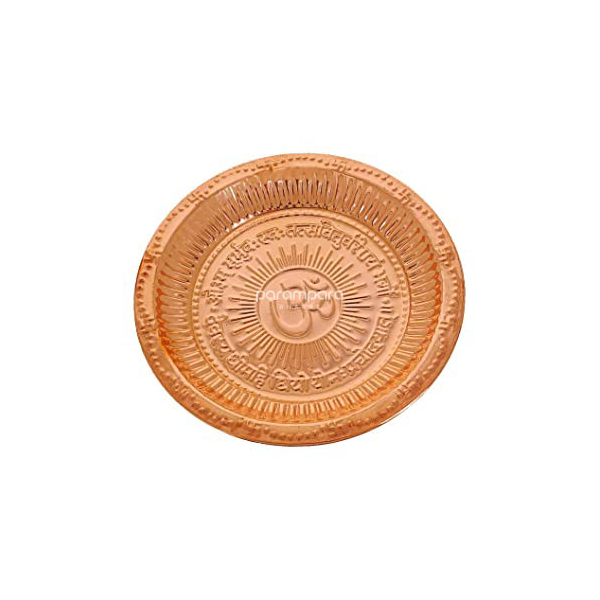

Om Thali in Copper
₹500.00
Description
- Pooja plate is used for keeping Pooja items during Pooja.
- The Pooja items kept in a Pooja plate include Roli for tilak, Akshat,Ghanti (bell),a small Kalash filled with water,Kalava to tie around the wrist,aarti-diya and some colorful flowers.
- The Pooja -thali has special significance for the festivals.Agarbatti,camphor,coconut,belpatra,betel leaves,sandalwood paste,candles, flowers,seasonal fruits and sweets (as Prasad) and silver or gold coins having image of Goddess Lakshmi,Lord Ganesh,Om,Swastika or Shree are also kept in a thali.
- Made in copper with OM and Gayatri mantra inscribed on it.
Specifications
- Material – Copper
- Pack of – 1
- Size – (W x H) 20.32 x 1.90 cm
- Weight – 150 g
Related products
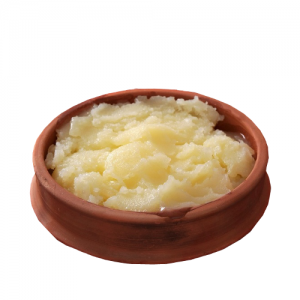
Ghee
Description
- Ghee holds its position of purity in nearly all the Hindu pooja rituals.
- In Hindu mythology, Prajapati/Brahma, created Ghee by rubbing or "churning" his hands together and then poured it into fire to engender his progeny.
- So, whenever the rituals are performed, the pouring of Ghee into fire symbolises a re - enactment of creation.
Quantity
- 200 gms
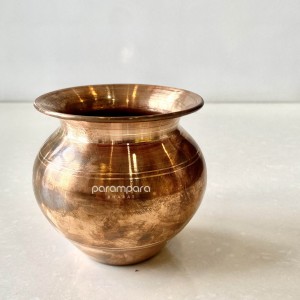
Cooper Plain Kalash
Description
- The Kalash symbolically represents creation. The vacant pot, symbolizes earth, and the water filled symbolizes the primordial water from which life began on earth.
- It is filled with water (preferably the water of holy Ganga, any sacred river or clean, running water).
- Its top open end holds betel or mango leaves and a red-yellow sanctified thread (kalawa or mauli) is tied around its neck.
- This kalash is placed on the pujavedi (worship dais or table) near the idols or pictures of the deity. It is placed facing the North, in the center.
- This positioning signifies balance; balance that one needs to achieve success in every walk of life.
- Often it is topped by a coconut or a deepak and kept on the sacred Vedic swastika symbol or a Vedic swastika is drawn on it by using wet vermillion, sandal-wood powder and turmeric.
Specifications
- Material: Copper
- Pack of - 1
- Size - (Top W x H): 8.5 x 9 cm
- Weight - 118 g

Lotus Seeds
Description
- Lotus seeds strengthens devotion and opens the heart for divine grace.
- Lotus seeds have the quality of sattva or purity and are associated with Vishnu, the preserver.
- The lotus being a symbol of growth, as it blooms beautifully even in the most unlikely, difficult environments, and is a metaphor for our own growth.
- Also called as Kamal Kakadi or Pabdi, these seeds are used an an offering to Goddess Laxmi and are also offered as a fire oblation while doing Mahalaxmi yagna.
Quantity
- 21 seeds

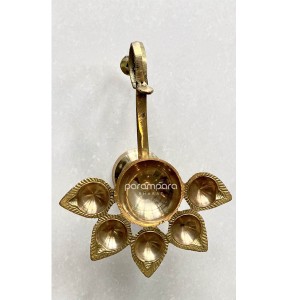
Brass Panchaarti (Small)
Description
- The importance of lighting a diya during worship can be traced back to Vedas.
- Light symbolizes knowledge and darkness, ignorance.
- The Lord is the “Knowledge Principle” (chaitanya) who is the source, the enlivener and the illuminator of all knowledge.
- Hence light is worshipped as the Lord Himself. Knowledge removes ignorance just as light removes darkness.
- Also knowledge is a lasting inner wealth by which all outer achievements can be accomplished.
- Hence we light the lamp to bow down to knowledge as the greatest of all forms of wealth.
- We therefore keep a lamp lit during all auspicious occasions as a witness to our thoughts and actions.
Specifications
- Material – Brass
- Pack of – 1
- Weight – 245 g

Havan Samagri
Description
- The Havan Samagri is a sacred offering in the yagna and each item of the samagri is significant.
- The havan samagri is offered in the fire during yagnas and homas, after completion of every mantra chant.
- Havan Samagri (a mixture of various dried herbal , roots and leaves) is offered in the ablazed fire which disseminates in micro form, in the air, to purify the environment besides activating the air as disinfectant germicidal agent.
- It is anti-bacterial and is made from high grade raw materials. It is 100% natural Havan Samagri.
Contents
- Made from ayurvedic havan exotic herbs, Black til, Jo, 32 types of dhoop, Bhimseni kapoor, rose petals, sandalwood powder, lobaan, ghee, chandan
Quantity
- 100 gms
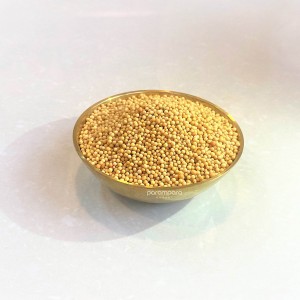
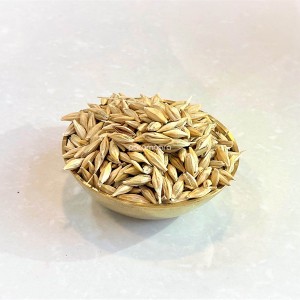
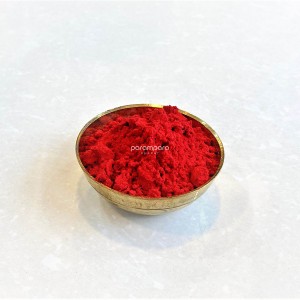
Kumkum Powder
Description
- Kumkum is applied to the forehead.
- The reason for this particular location has to do with the ancient Hindu belief that"the human body is divided into seven vortices of energy,called chakras,beginning at the base of the spine and ending at the top of the head.
- The sixth chakra, also known as the third eye,is centered in the forehead directly between the eyebrows and is believed to be the channel through which humankind opens spiritually to the Divine".
- Thus,the kumkum is placed at the location of the body which is the most holy.
Uses
- Kumkum powder is widely used for worshiping the Hindu goddesses,especially Shakti and Lakshmi.
- Saivites- Followers of Siva usually apply three white horizontal lines with a dot of kumkum at the center.
- Vaisnavas- Followers of Vishnu make use of "white clay to apply two vertical lines joined at the base and intersected by a bright red streak." Many times the white clay is applied in a U-shape.
- Swaminarayana- Followers of the Swaminarayana apply kumkum at the center of the forehead and in between a U-shaped tilaka.The tilaka is normally yellow and made from sandalwood.
- When a girl or a married woman visits a house,it is a sign of respect (in case of an elderly lady) or blessings (in case of a young girl) to offer kumkum to them when they leave.
- When visiting a temple or during a pooja,apply a dot on your forehead.
- In most of India, everyday, married women apply red kumkum in front of their parting on their forehead as a symbol of marriage
Quantity
- 50 gms , 100 gms

Reviews
There are no reviews yet.