


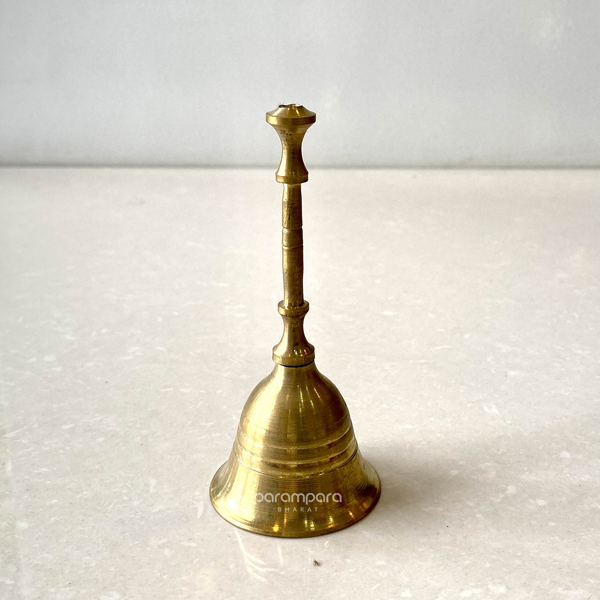

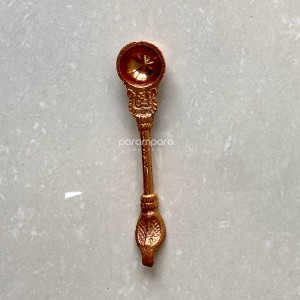
Brass Bell
₹150.00
Description
- This beautifully detailed brass bell is designed to be rung during the puja.
- The symbolic element of ringing a bell during a Puja is that the chime of the bell, especially that of the deep, sonorous bell, is very similar to the sound of the Primal Sound, the “Aum”.
- The ringing of the bell is said to dispel evil forces, focus the mind, and its beauty is said to attract even the gods, thus taking away everything that is time-space oriented, and finally letting the devotee touch the plane of the absolute, the one that simply “IS”.
- Made of thick brass with long lasting finish.
Specifications
- Material – Brass
- Pack of – 1
- Weight – 47 g
Related products
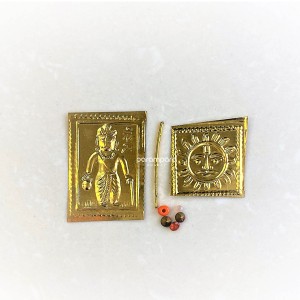
Vastu pratima
Description
- Vastu is the science of direction that combines all the five elements of nature and balances them with man and materials.
- It is all about the interaction of various forms of best effect on a living person.
- It aims to create a subtle conducive atmosphere in a structure in which we can bring the best in ourselves, thereby paving the way for enhanced health, wealth, prosperity and happiness in an enlightened environment.
- Like any other science, vaastu is universal, rational, practical and utilitarian. It is not a religion but a science.
Uses
- Place this Vastu pratima under the ground in the North east corner of the house, while doing vastu pooja.
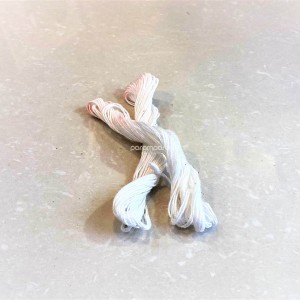
Janeu
Description
- The Janeu provides three strands, which symbolizes Hinduism's sacred trinity- Lord Brahma, Lord Vishnu & Lord Shiva.
- It is also synonymous with the three Vedas -Rig Veda, Sama Veda & Yajur Veda.
- In addition, they symbolize the three qualities - satogun - purity & goodness, Rajogun -love of delicate pleasure & Tamogun – inferior qualities. 20 pcs Gatta The size of janeu is full.
Quantity
- Set of - 2
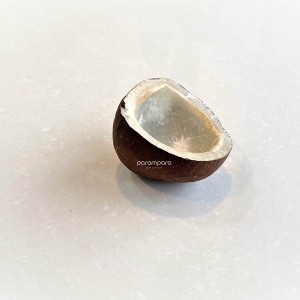
Dry Coconut
Description
- We never offer the coconut as it is.
- We remove the fibre that covers it and offer the fruit that is free from all the external fibre.
- Only then is it possible to break the coconut.
- By breaking the coconut, the water in it flows out.
- The heart is the coconut and it is covered by the fibre of desire.
- The water that flows out is the 'Samskara' or purification. The fibres on the surface are the desires.
- We must strip the heart of all desires and offer the core without the fibre. It then becomes an offering to God.
- If we plant a coconut as it is, in course of time and by watering it, another plant will grow out of it.
Used
- Dry coconuts are used as an offering to deities and especially during the final oblation (purna-ahuti) of any homa/yagna.
- It is filled with sugar and ghee and is then closed with a sacred thread, before offering to the homa fire.
Quantity
- 360 gm - Broken pieces of 2 coconuts

Brass Samai (Big)
Description
- Oil lamps are an integral part of every puja ritual and yajna.
- During the Aarti, the lamp is lit and is rotated in clockwise direction as a sign of invoking the energies of the deities.
- After the completion of Aarti, all devotees take the blessings from fire god.
- This Samai can lit five wicks simultaneously and has a holder in the center.
- Its religious appeal makes it a must-have for every altar to invoke the divine blessings.
- Made of thick brass with long lasting finish.
- Artistic carving and fine finish.
Specifications
- Material - Brass
- Pack of - 1
- Size - 65 cm (Height) , (Top W) 15 cm x 13 cm (Bottom W)
- Weight - 3 kg
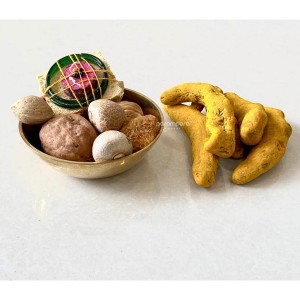
Pooja Ooti
Description
- Essential ingredients for offering to deities during daily worship.
Contents
- Mix of 5 dry fruits Walnut, Almond, Dates, Betelnut, Turmeric (Akhrot, Badam, Kharek, Supari, Haldi) - 5 pieces each.
- Karanda Phani: The vastra (clothing) made out of cotton and haldi (turmeric) and kumkum (vermilion) and Saubhagyalen (i.e green bangles, mangalsutra) is called 'Karanda Phani'.
Quantity
- 1 pcs each
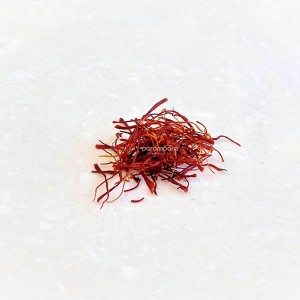
Kesar
Description
- Kesar have been derived from the Northern Indian region, Kashmir, where old saffron was produced.
- Saffron is the most expensive spice in the world.
- Saffron's aroma is unique and there is no substitute for it.
- It is offered to deity idols and afterwards distributed and smeared on the foreheads of devotees.
Quantity
- 0.025 gms

Reviews
There are no reviews yet.