


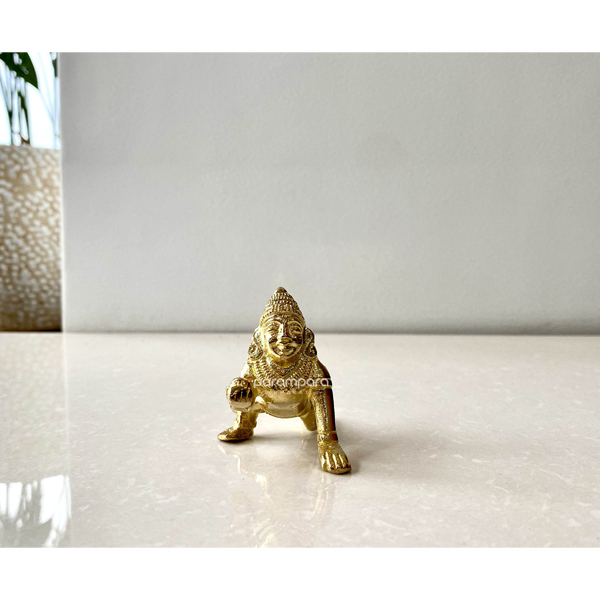
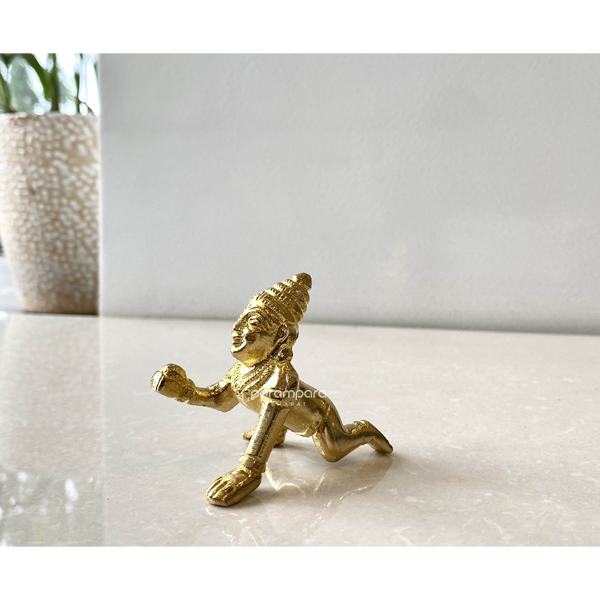
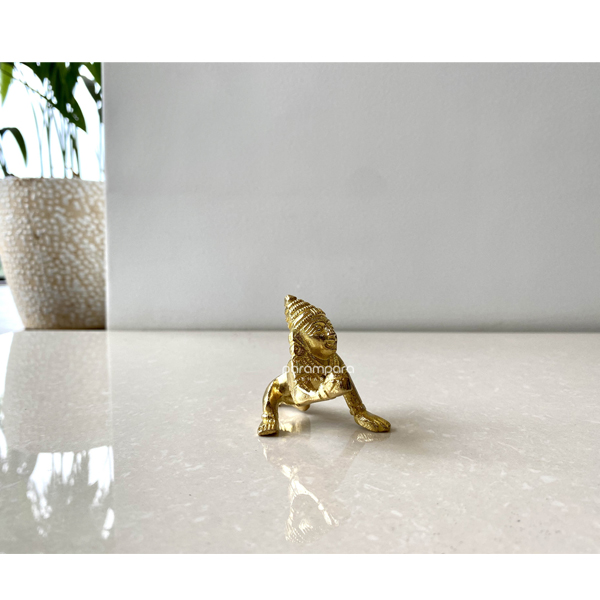
Bal Gopal Krishna Idol
₹410.00
Description
- A beautiful idol of Bal Gopal Lord Krishna with flute made in solid brass. This statue has a special last long finish.
- Shree Krishna, the all-attractive-one; Megh-varna, the one with the color-of-clouds; Go-pal, Murli-manohar, who steals hearts by the melody of his flute; and Madan-Mohan who can mesmerize Cupid himself with His beauty.
Specifications
- Material – Brass
- Pack of – 1
- Size – 5.5 x 3.5 x 5 cm
- Weight – 0.086 kg
Related products
Kumkum Powder
Description
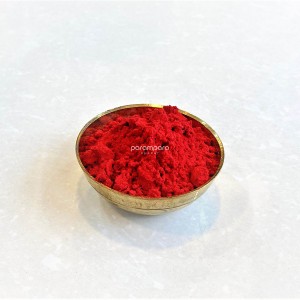
- Kumkum is applied to the forehead.
- The reason for this particular location has to do with the ancient Hindu belief that"the human body is divided into seven vortices of energy,called chakras,beginning at the base of the spine and ending at the top of the head.
- The sixth chakra, also known as the third eye,is centered in the forehead directly between the eyebrows and is believed to be the channel through which humankind opens spiritually to the Divine".
- Thus,the kumkum is placed at the location of the body which is the most holy.
Uses
- Kumkum powder is widely used for worshiping the Hindu goddesses,especially Shakti and Lakshmi.
- Saivites- Followers of Siva usually apply three white horizontal lines with a dot of kumkum at the center.
- Vaisnavas- Followers of Vishnu make use of "white clay to apply two vertical lines joined at the base and intersected by a bright red streak." Many times the white clay is applied in a U-shape.
- Swaminarayana- Followers of the Swaminarayana apply kumkum at the center of the forehead and in between a U-shaped tilaka.The tilaka is normally yellow and made from sandalwood.
- When a girl or a married woman visits a house,it is a sign of respect (in case of an elderly lady) or blessings (in case of a young girl) to offer kumkum to them when they leave.
- When visiting a temple or during a pooja,apply a dot on your forehead.
- In most of India, everyday, married women apply red kumkum in front of their parting on their forehead as a symbol of marriage
Quantity
- 50 gms , 100 gms
Copper Panchapatra
Description
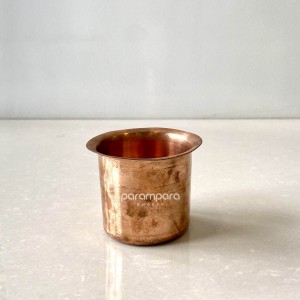
- copper panchpatra is an integral part of poojas where in the holy charan amrit is placed before the pooja and then distributed upon the Pooja's completion.
- The Charanamrit literally means Amrit (Holy Nectar) from the Charan (Feet of the Lord) of the worshipped deity and is partaken as a sacred offering or a holy gift after the completion of the pooja.
- In many Hindu homes the cooked food is first offered to the Lord each day and is then consumed by everyone else.
- The offered food is mixed with the rest of the food and then served as prasad.
Specifications
- Material - Copper
- Pack of - 1
- Size - (W x H) 7 x 6 cm
- Weight - 33 g
- Capacity - 100 ml
Janeu
Description
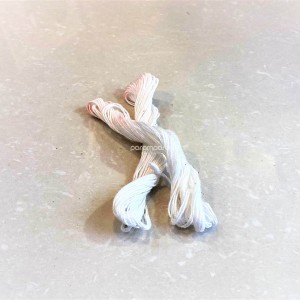
- The Janeu provides three strands, which symbolizes Hinduism's sacred trinity- Lord Brahma, Lord Vishnu & Lord Shiva.
- It is also synonymous with the three Vedas -Rig Veda, Sama Veda & Yajur Veda.
- In addition, they symbolize the three qualities - satogun - purity & goodness, Rajogun -love of delicate pleasure & Tamogun – inferior qualities. 20 pcs Gatta The size of janeu is full.
Quantity
- Set of - 2

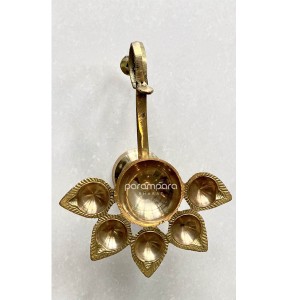
Brass Panchaarti (Small)
Description
- The importance of lighting a diya during worship can be traced back to Vedas.
- Light symbolizes knowledge and darkness, ignorance.
- The Lord is the “Knowledge Principle” (chaitanya) who is the source, the enlivener and the illuminator of all knowledge.
- Hence light is worshipped as the Lord Himself. Knowledge removes ignorance just as light removes darkness.
- Also knowledge is a lasting inner wealth by which all outer achievements can be accomplished.
- Hence we light the lamp to bow down to knowledge as the greatest of all forms of wealth.
- We therefore keep a lamp lit during all auspicious occasions as a witness to our thoughts and actions.
Specifications
- Material – Brass
- Pack of – 1
- Weight – 245 g
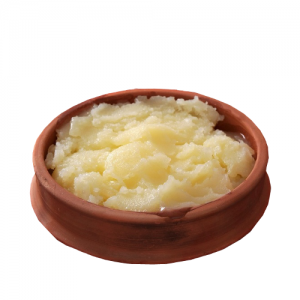
Ghee
Description
- Ghee holds its position of purity in nearly all the Hindu pooja rituals.
- In Hindu mythology, Prajapati/Brahma, created Ghee by rubbing or "churning" his hands together and then poured it into fire to engender his progeny.
- So, whenever the rituals are performed, the pouring of Ghee into fire symbolises a re - enactment of creation.
Quantity
- 200 gms
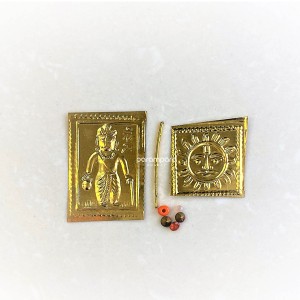
Vastu pratima
Description
- Vastu is the science of direction that combines all the five elements of nature and balances them with man and materials.
- It is all about the interaction of various forms of best effect on a living person.
- It aims to create a subtle conducive atmosphere in a structure in which we can bring the best in ourselves, thereby paving the way for enhanced health, wealth, prosperity and happiness in an enlightened environment.
- Like any other science, vaastu is universal, rational, practical and utilitarian. It is not a religion but a science.
Uses
- Place this Vastu pratima under the ground in the North east corner of the house, while doing vastu pooja.

Brass Samai (Big)
Description
- Oil lamps are an integral part of every puja ritual and yajna.
- During the Aarti, the lamp is lit and is rotated in clockwise direction as a sign of invoking the energies of the deities.
- After the completion of Aarti, all devotees take the blessings from fire god.
- This Samai can lit five wicks simultaneously and has a holder in the center.
- Its religious appeal makes it a must-have for every altar to invoke the divine blessings.
- Made of thick brass with long lasting finish.
- Artistic carving and fine finish.
Specifications
- Material - Brass
- Pack of - 1
- Size - 65 cm (Height) , (Top W) 15 cm x 13 cm (Bottom W)
- Weight - 3 kg
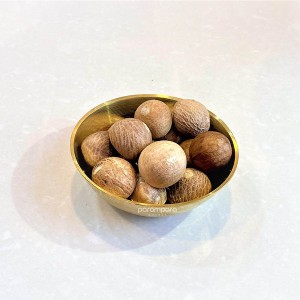
Supari / Betelnut
Description
- The betel nut/Supari is an integral part of the daily or ritualistic Pooja.
- It is also popularly used in the age old-custom of Indian eating.
- The supari is symbolic of the nut of the ego that must be offered on the altar of God.
- It represents the hard, coarse qualities that must be surrendered to God, leaving only the soft, pure qualities.
- Mostly symbolic, the Supari is many a times traditionally represented as the Nine planets (in the Navgrah Pooja) and takes the form of Deities like Brahma, Surya and others during different Pooja.
Quantity
- 11 pieces

Reviews
There are no reviews yet.